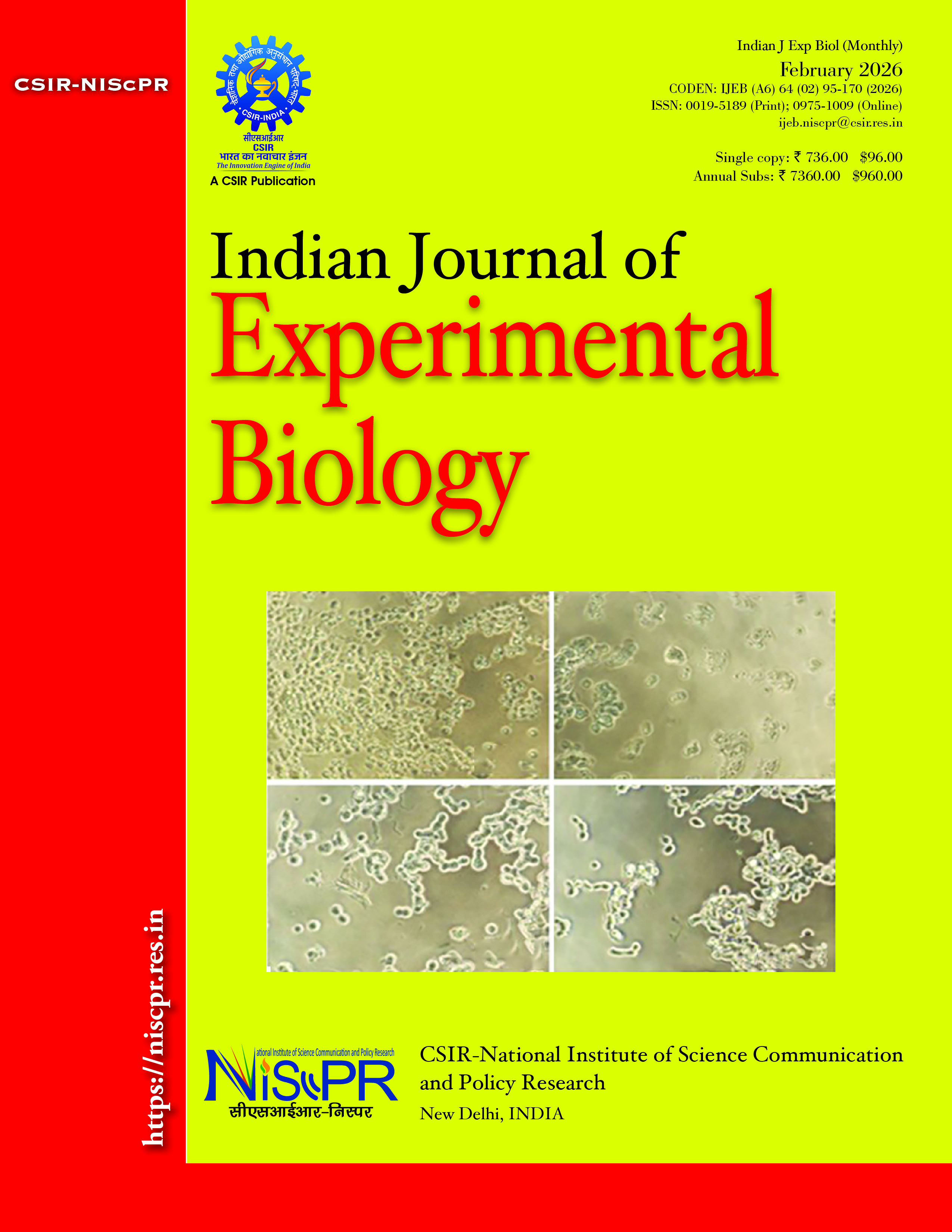
Heterocyclic aromatic compounds from Artemisia judaica (L.) induced caspase-3 mediated apoptosis in metastatic breast cell lines
Artemisia judaica induced caspase-3 mediated apoptosis
DOI:
https://doi.org/10.56042/ijeb.v64i02.15900Keywords:
Apoptosis, Aromatics, Caspase-dependent mitochondrial pathway, Cytotoxicity, Spectroscopy analysis, Triple-negative breast carcinomaAbstract
Chemoradiotherapeutic drugs remain a major clinical challenge for breast cancer patients due to their non-selective toxicity toward both malignant and healthy cells. The purpose of this study was to identify the aromatic organic compounds present in the ethanolic extract of Artemisia judaica (ArJ) and to evaluate their selective cytotoxic, oxidative-stress–mediated, and apoptosis-inducing effects against various breast cancer cell lines. In this study, several aromatic heterocycle compounds including benzamide, oxadiazine, benzofuran-carboxylic acid, and pyrimidine derivatives were identified in the ethanolic extract of ArJ using FT-IR and GC-MS spectral analysis. The cytotoxic and antiproliferative activities of the extract were assessed in normal human skin fibroblasts (HSF) and breast cancer cell lines (MCF-7, T47D, and MDA-MB-231) following 24 and 48 hours of treatment. ArJ extract exhibited minimal toxicity toward HSF cells (IC50 = 123.9 ± 3.86 µg/mL; selectivity index > 2), whereas a pronounced, time-dependent cytotoxic effect was observed in the metastatic MDA-MB-231 cells, with IC50 values of 35.62 ± 2.29 µg/mL, 16.93 ± 2.17 µg/mL, and 9.76 ± 2.03 µg/mL at 24, 48, and 72 hours, respectively. Treatment with ArJ significantly increased intracellular reactive oxygen species (ROS), disrupted mitochondrial membrane potential, and elevated caspase-3 activity, leading to cell-cycle arrest and apoptosis. In contrast, doxorubicin induced higher necrotic cell death and demonstrated greater toxicity toward normal cells. These findings suggest that the aromatic organic compounds present in ArJ exert selective and potent anticancer effects particularly against metastatic MDA-MB-231 cells through a ROS-mediated, mitochondrial caspase-dependent apoptotic pathway, highlighting their potential as safer alternatives to conventional chemotherapeutics.