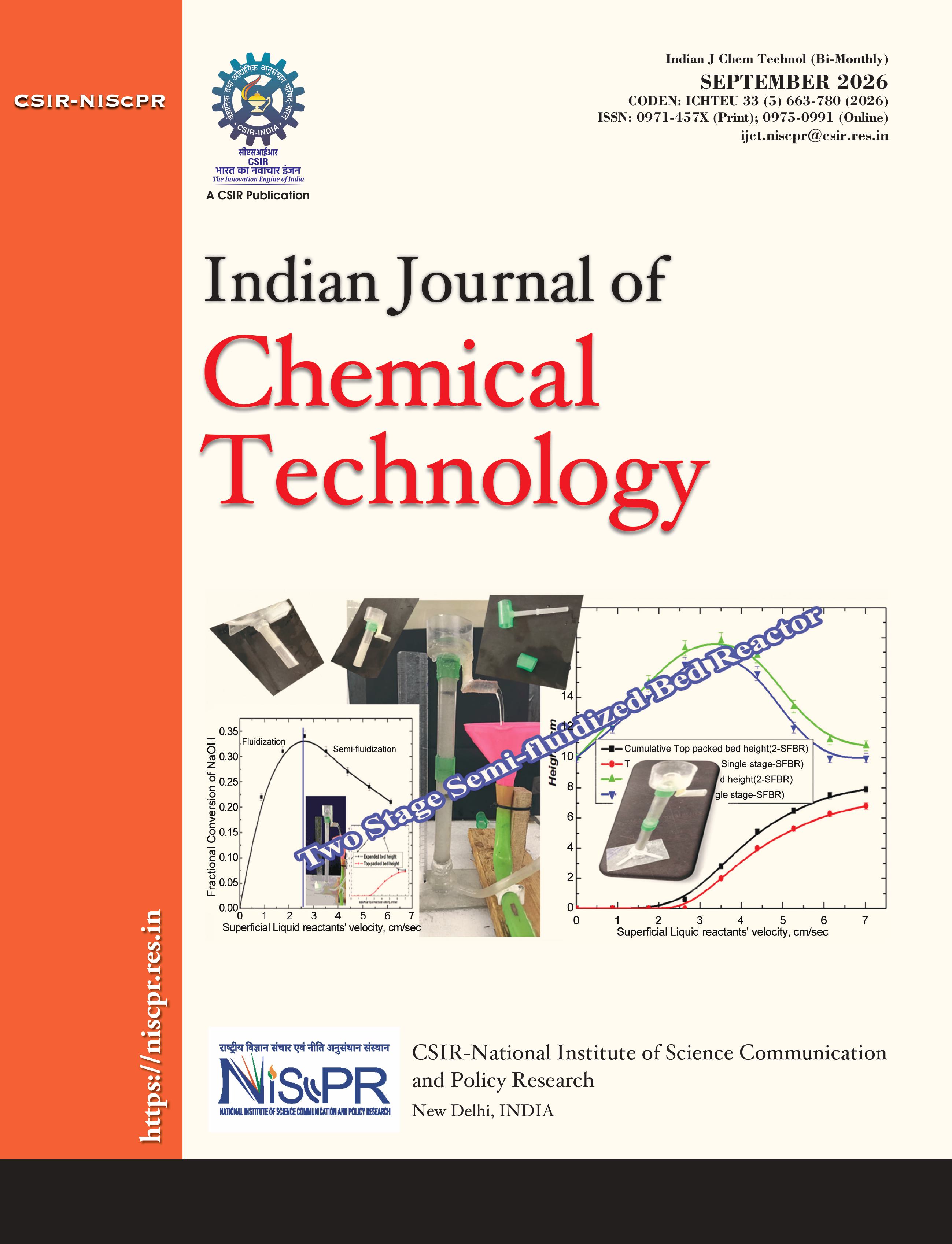
Two-stage semi-fluidized bed reactor: A comparative mini-scale experimental investigation
DOI:
https://doi.org/10.56042/ijct.v33i5.25715Keywords:
Conversion, Fluidization, Packed bed, Saponification, SFBR, Two-stageAbstract
In the present investigation, a two‐stage semi‐fluidized bed reactor (2‑SFBR) has been evaluated at mini-scale and compared directly with a single‐stage SFBR under identical operating conditions. The indigenously fabricated reactor comprises a Perspex tube, fitted with a 40-mesh stainless steel screen strainer as required. The spherical glass beads (≈ 700 µm diameter) as solid phase provide the dry packed bed height of 100 mm in the semi-fluidized liquid phase reactor. The saponification reaction between equal flow rates of sodium hydroxide and ethyl acetate was carried out for both single-and two-stage SFBR configurations. Over the tested superficial flow-velocity range, the 2‑SFBR achieved a 9‑15% higher conversion of NaOH than the single-stage SFBR. The findings suggest that incorporating alternating fluidized and packed bed zones in multiple-stage SFBRs can significantly improve liquid phase reaction conversion. These insights are expected to facilitate the design and scaling of multi-stage SFBRs in future applications in the chemical and biochemical process industries. The present study emphasizes the future potential of two-stage SFBRs over other reactors for fast spontaneous reactions, especially prevalent in fertilizer and pharmaceutical industries.