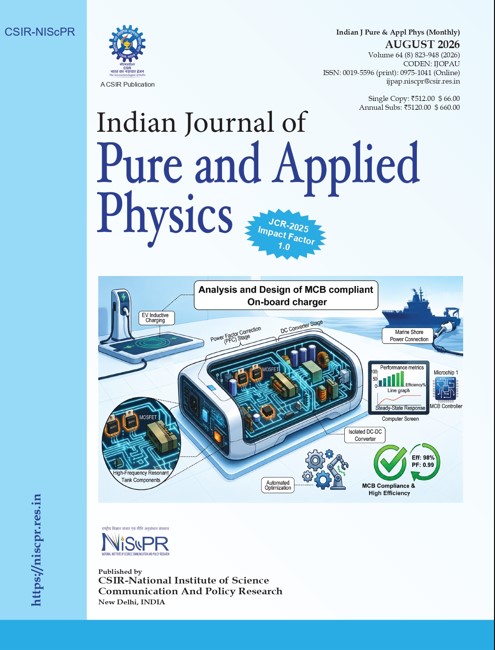
Analysis and Design of MCB Compliant On-Board Charger based on Topologies, Efficiency, Losses, and Automation
DOI:
https://doi.org/10.56042/ijpap.v64i8.30900Keywords:
Electric vehicles (EVs), Electric vehicle supply equipment (EVSE), On-board charger (OBC), Master control board (MCB), Power factor corrector (PFC), Series resonant converter (SRC), DC-DC converter, Controller area network (CAN), Pulse width modulation (PWM), Ziegler-nichols tuningAbstract
This paper presents a structured design approach for an Onboard Charger (OBC) used in electric vehicles (EVs) and Marine metro vehicles, encompassing both hardware and software perspectives. The OBC architecture is typically divided into two stages the Power Factor Correction (PFC) stage and the DC-DC converter stage. For high-voltage battery charging that follows a Constant Current and Constant Voltage profile, a Boost PFC combined with a DC-DC converter controlled by an algorithm is considered an effective solution. Three PFC topologies are explored: Conventional Boost PFC, Interleaved Boost PFC, and Semi-bridgeless PFC. For the DC-DC conversion stage, the paper discusses Full-Bridge Converter, Series Resonant Converter (SRC), and Phase-Shift Full-Bridge Converter. To automate the switching operation of the Boost Converter, a Proportional-Integral (PI) controller is implemented. Beyond hardware design, the paper introduces a method to fully automate OBC operations by integrating the Renesas RH850 E2M microcontroller. This next-generation automotive power train MCU enhances the OBC with intelligent charging capabilities. Specific ECU software modules of the RH850 E2M are mapped to corresponding ECU hardware components within the OBC and the EV system. These modules enable smart features such as adaptive charging control, fault detection, and system optimization. A logical model of key ECU software modules responsible for smart charging is developed and simulated using MATLAB Simulink and Simscape. The simulation results validate the proposed design and demonstrate its potential for efficient and intelligent EV charging.
Downloads
Published
Issue
Section
License
Copyright (c) 2026 Indian Journal of Pure & Applied Physics (IJPAP)

This work is licensed under a Creative Commons Attribution 4.0 International License.


