Intelligent Fault Detection in PSO-MPPT based Photovoltaic and Electric Vehicle Integrated System Under Partial Shading Conditions
DOI:
https://doi.org/10.56042/ijpap.v64i2.25940Keywords:
Photovoltaic (PV), Electric Vehicle, Particle Swarm Optimization, Partial shadingAbstract
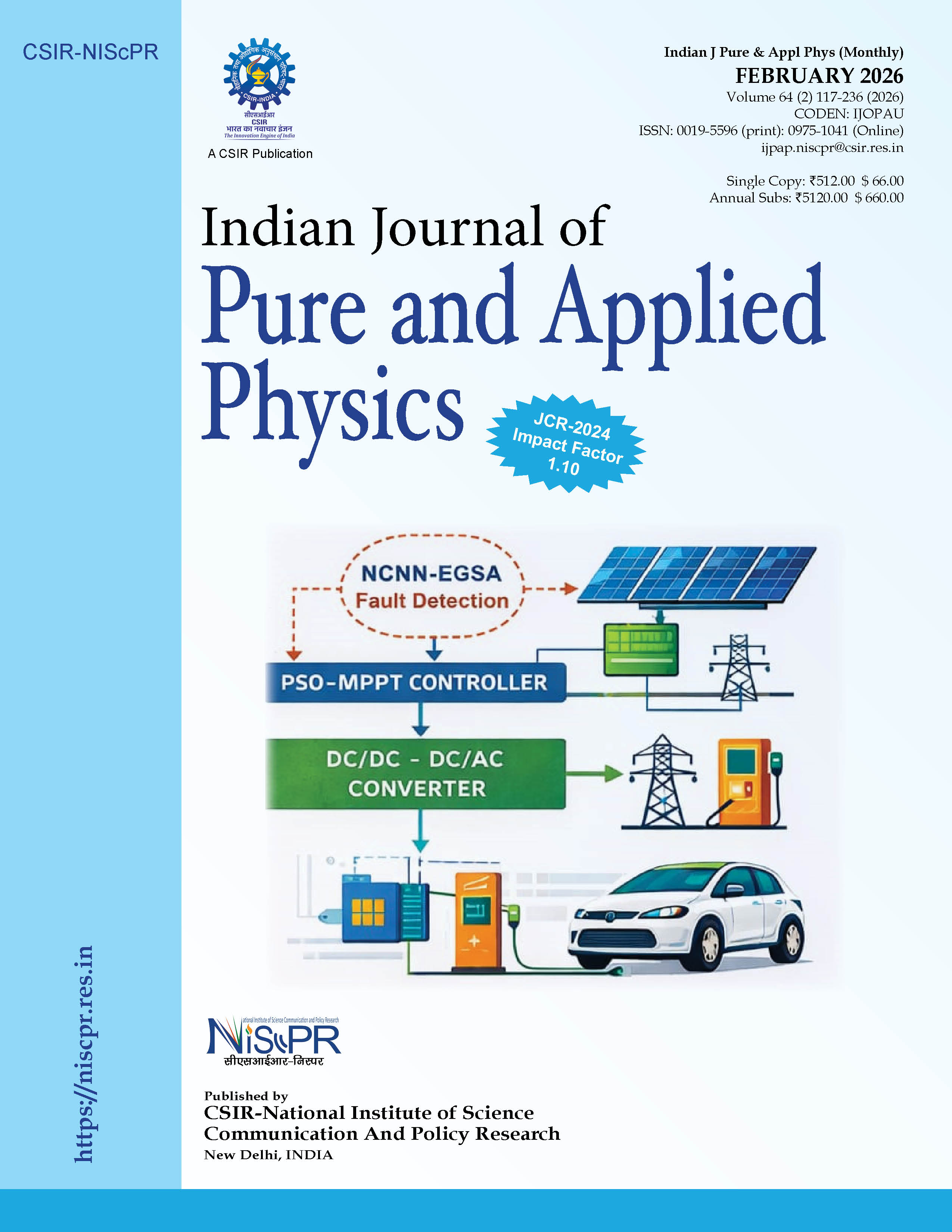
A method to amend the operation of a Photovoltaic (PV) system plus Electric vehicles (EVs) integrated system, under varied partial shading conditions and varying irradiance conditions using an optimized Maximum Power Point Tracking (MPPT) technique. As solar energy becomes more popular, it's crucial to optimize PV panel efficiency to meet growing demand. Nevertheless, PV panels face challenges, including Partial Shading Conditions (PSCs), which significantly impacts their efficiency. In this study, Particle Swarm Optimization (PSO) algorithm based MPPT is used to calculate the Global Maximum peak point (GMPP) from peak power measurements and an improved grid management scheme based on a Novel Convolutional Neural Network (NCNN) was developed and trained using an Enhanced Golden Search Algorithm (EGSA). EGSA can adjust hyperparameters effectively, which promotes model performance and accelerates the convergence rate. Partial shading-induced faults are identified with high sensitivity, and a diagnosis accuracy of 99.6 % and a fast response time of 0.45 s are obtained. With the help of Simulation results the efficacy of the propositioned method is tested and validated.
Downloads
Published
Issue
Section
License
Copyright (c) 2026 Indian Journal of Pure & Applied Physics (IJPAP)

This work is licensed under a Creative Commons Attribution 4.0 International License.


