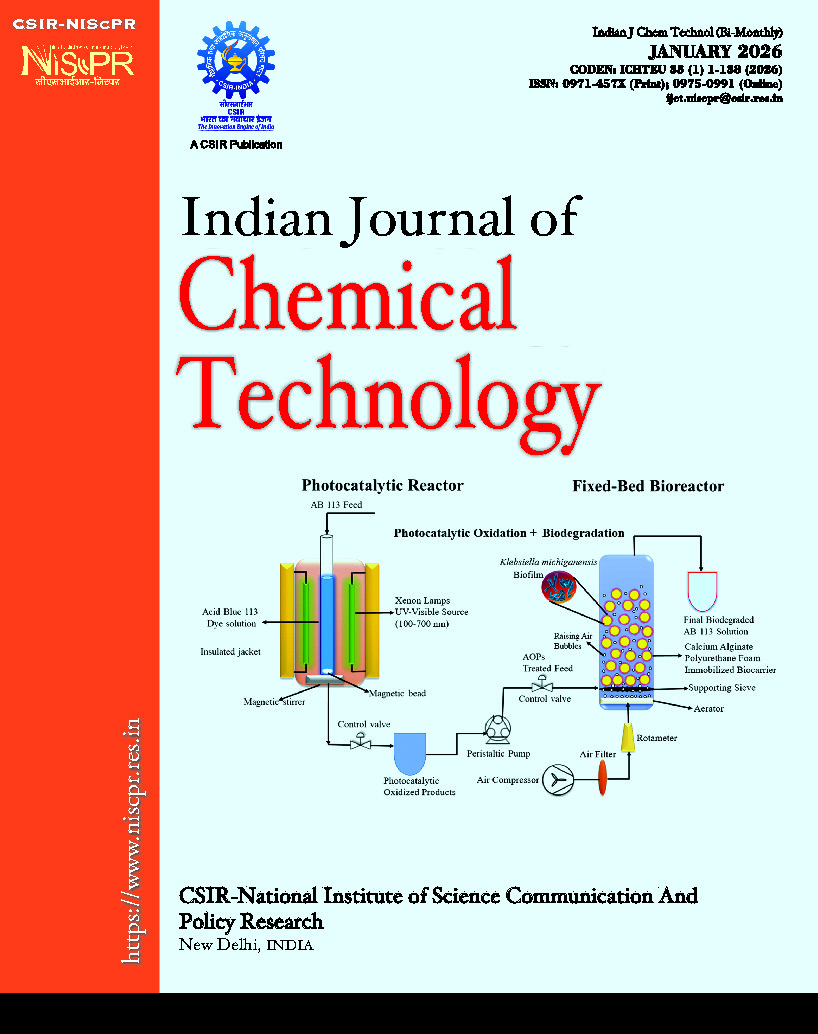
Pioneering degradation of acid blue 113 Dye with photocatalysis and bioremediation in a novel sequential reactor
DOI:
https://doi.org/10.56042/ijct.v33i1.18899Keywords:
Fixed bed bioreactor, Hydrothermal method, Permanganate index, Photocatalytic reactor, TiO₂/GO compositeAbstract
In this study, a novel approach is elucidated by utilizing a synergistic combination of photocatalytic oxidation and bioremediation for the degradation of Acid Blue 113 dye. TiO2/GO composite is employed as a photocatalyst in the photocatalytic reactor, while polyurethane foam is used as packing media to immobilize the microbes in a fixed bed bioreactor. TiO2/GO composite has been prepared using a one-step hydrothermal technique and characterized through FTIR, HR-XRD, SEM, and BET analyses, revealing its structural and morphological properties. The energy band gap of the composite is determined to be 2.73 eV. Preliminary photocatalytic oxidation of the Acid Blue 113 dye demonstrated a notable improvement in the biodegradability index (BOD/COD = 0.416 ± 0.0128) and a significant reduction in the permanganate index (66.18%). Furthermore, the application of a fixed bed bioreactor proved highly effective in mitigating dye loading stress and exhibited excellent dye biodegradation efficiency. The bioreactor system demonstrated its remarkable capability of 85.03 ± 2.76% biodegradation of the dye loading of 700 mg/L. Additionally, residual toxicity assessment ensured the safe disposal of the treated dye wastewater into the environment.